State of Financial-Data MCPs (November 2026): 30 Vendors, Agent-Tested
Your biggest clients' big agent jobs need a documented route. Of 30 financial-data vendors, about 40% show no route; the agent's fallback was right in 2 of 6 runs.
Your biggest clients' large jobs depend on a route many vendors don't document. In the public docs of 30 financial-data vendors (November 2026), about 40% show no route for a large request. In Oryx's tests (Claude Haiku 5.5 in Claude Code, test providers), an agent asked about 240 companies looped one call per company and got the right final number in 2 of 6 runs, against 100% of counted runs with a route built for large jobs.
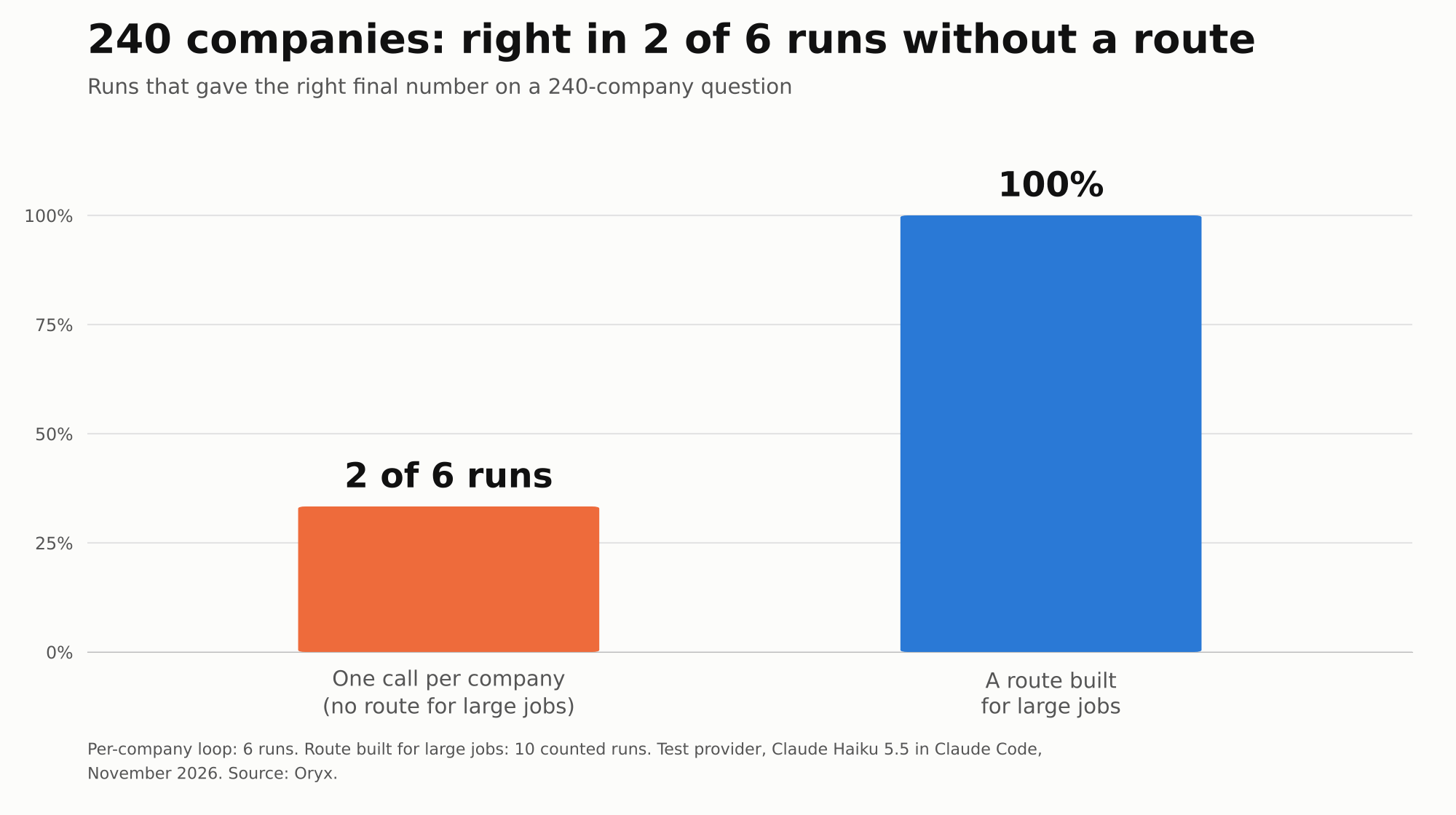 Per-company loop: 6 runs. Route built for large jobs: 10 counted runs. Test provider, Claude Haiku 5.5 in Claude Code, November 2026.
At a glance: six patterns in financial-data MCPs
- Your biggest clients' jobs can fall short. About 40% show no route; at 240 companies, the agent's loop was right in 2 of 6 runs.
- Raw responses can cost clients more. About 60% don't say what their MCP returns; dense raw responses made runs about 10 times dearer.
- The agent can misread scale. 0% of audited vendors state scale; the agent reported $1.94 million instead of $1,940 million in 2 of 3 runs.
- Restated values can read as first reports. 0% of audited vendors flag them; in one pipeline case, the agent misread them in 28% of runs.
- Errors can look like no data. About 30% of audited vendors return them; one failed first call sent a provider's answers elsewhere.
- Thin wrappers got fewer answers right. About 48% of MCPs mirror their API; a thin wrapper got 73% right, a server built for agents 100%.
Do AI agents choose your MCP server, and get its numbers right? Book a 15-minute technical briefing →
Why these patterns matter for share of agent answers, accuracy and renewals
We read the public MCP and API docs of 30 financial-data vendors, then tested what an AI agent does when a server has each pattern we found.
Those tests are part of Oryx's evaluation framework: more than 2,000 graded agent sessions on 69 known-answer financial-data tasks, as of November 2026.
What each pattern does to a number you own:
- GTM and partnerships: with no route for big jobs, your biggest clients' agent jobs can stop partway. Those are the accounts renewals ride on.
- MCP and API product: when the agent can't read a pattern, it picks another source or misreads the data. That's connector adoption, active usage and agent share. Agent share is the share of agent answers that rest on your data.
- Data quality and evals: with no scale or restatement flag, wrong numbers can go out under a vendor's name. That's accuracy, data-error complaints and support tickets.
The step from our test results to renewals, agent share and complaints is our read.
How we did this
We did two separate things: we read public documentation, and we tested agents. The two are counted separately and never added together.
Our review of public documentation. We read the public MCP and API docs of 30 financial-data vendors, plus their published server code where it existed. They cover statements, prices, filings, estimates, news, credit, indices, crypto and market microstructure. We read everything between 12 and 14 November 2026, with no logins and no paid calls, and audited 10 of the 30 in depth. "Not found" means the public material didn't say. Every figure is rounded and directional. The patterns come from a review checklist of 88 items in ten topics.
Agent tests. We connected an AI agent (Claude Haiku 5.5 in Claude Code, November 2026; Claude Sonnet too on the undocumented-default test) to test financial-data providers serving the same seeded data. We asked real analyst questions and changed one thing at a time, with 3 to 32 runs per setup. The response-cost comparison was an early check with one run per setup. "Right" means within 1% of the true value. "Used" means the number in the answer came from that provider.
Part of Oryx's evaluation framework, as of November 2026: more than 2,000 graded agent sessions · 69 known-answer tasks · more than 20 experiments · seven test providers, about 30 setups with competing providers in the same session · two Claude models · more than 19,000 tool calls.
We left out 636 runs that we voided or used only to set up tests. Built to re-run on each new model release.
The failed-call and near-duplicate-tool results ran on our direct API runner, not Claude Code; the near-duplicate result was also checked in Claude Code. List order is Claude Code's.
Limits: no real vendor's server was tested, so whether a real vendor with the same pattern sees the same effect is our read. Other models and agent clients are untested.
Big jobs: about 40% show no route
About 40% of the 30 financial-data vendors document no route for a large request Public docs, such as fundamentals for thousands of companies. By route we mean any documented way for an agent to get a request that size done. About 73% never say where large work should go; about 23% point agents somewhere else: bulk files, data shares or an API.
So we asked an agent about 240 companies Measured. With the usual one-company-at-a-time tool, it looped one call per company and got the right final number in 2 of 6 runs. In the other runs it fell short: it stopped partway through the list without an answer, ran out of budget, or left a total in its reply without recording it as the answer.
With a route built for large jobs, the agent was right in 100% of counted runs, at about 2-4% of the loop's model cost.
What about the vendor's API? Left to itself, the agent found it in 1 of 6 runs. When we told it an API existed, it read the API docs and still kept the MCP on 1- and 20-company jobs. Its reason, in one run:
"…since the MCP tool already returned the data"
In our tests, the MCP was where the agent started and, on smaller jobs, where it stayed. Whatever a vendor's docs say about large work is what the agent has to go on.
Your biggest clients run the biggest jobs. A job that stops partway or runs out of budget lands on exactly the accounts your renewals ride on.
Why you can't see it: On your side, a failed big job looks like heavy usage: hundreds of calls, each one answered. Nothing in your logs says the job never produced its answer.
What comes back: about 60% don't say
About 60% of the 30 vendors don't document what their MCP returns Public docs. Of the servers whose output we could classify, 6 of the 9 paste raw data straight into the agent's conversation.
When the format isn't documented, neither the client's developer nor the agent knows what's coming until it arrives. The agent has to carry all of it. In an early, small test, realistically dense raw responses made agent runs about 10 times dearer than thin ones Measured. One single-company lookup session put about 71,000 characters of tool output into the conversation, across several calls.
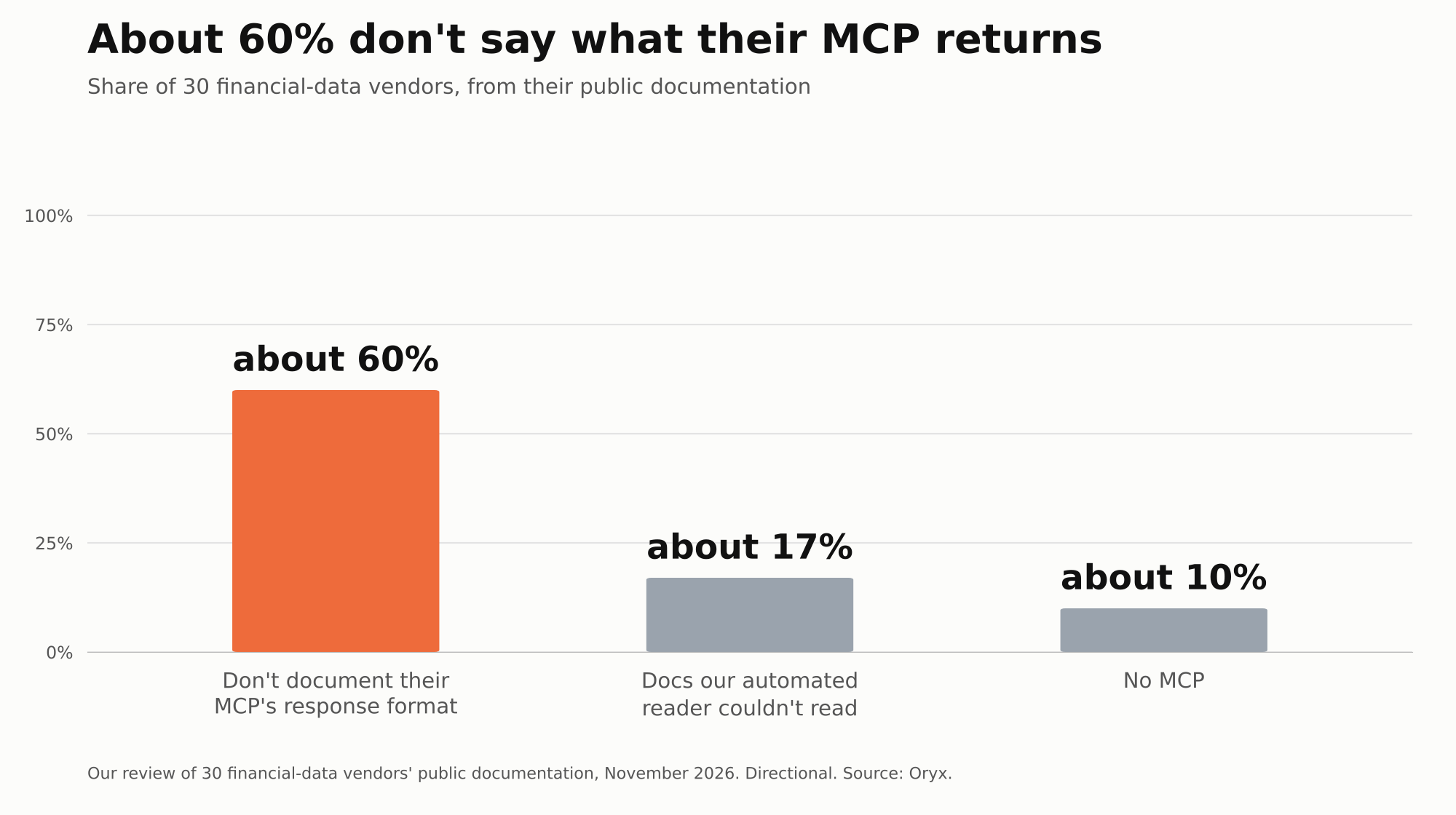 Our review of 30 financial-data vendors' public documentation, November 2026. Directional.
Dense output isn't wrong output: every number in it can be right, and the run still costs your client far more than a thin one. A client whose agent runs cost that much more is a client weighing its sources, and "what does an agent run on your data cost?" becomes a renewal question.
Why you can't see it: That cost lands on your client's agent bill, not on your server, so nothing on your side shows it.
Do you know how much of a client agent's context one of your answers takes up?
What the data doesn't say: 0% state scale or flag restatements
0% of the 10 vendors we audited in depth tell the agent the scale of their money values Public docs. On a single lookup with no scale stated, the agent reported $1.94 million instead of $1,940 million in 2 of 3 runs, in each of two batches Measured. It noticed that no scale was given and inferred one from the size of the number.
When the agent had a second number to reconcile, it caught the scale in 100% of runs. So the risk sits in single lookups: one company, one figure, one answer, and nothing to check it against.
0% of the audited vendors flag a restated value in the response Public docs. In one analysis pipeline case we tested, the agent read restated rows as first reports in 28% of runs Measured. A restated figure read as a first report can turn into a growth rate that never happened.
One more measured example. An undocumented default gave the same wrong number in 100% of runs: −4.41% instead of +3.47%, sign flipped, on both Claude models we tried.
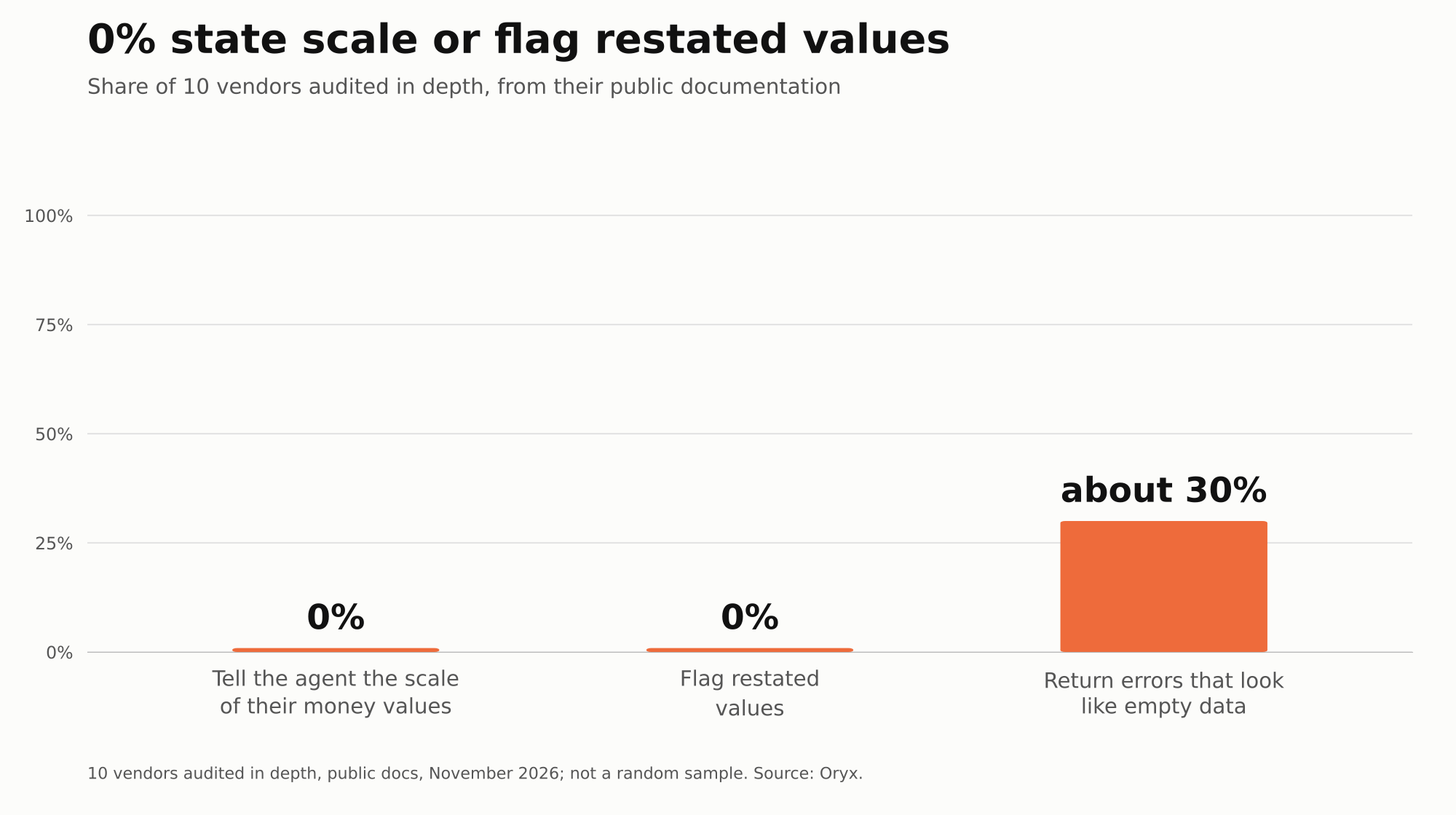 10 vendors audited in depth, public docs, November 2026; not a random sample.
In each of these, the provider's data was right. The number in the answer wasn't. For a data-quality or evals lead, that's accuracy, and it comes back as data-error complaints and support tickets.
Why you can't see it: These answers came back as clean responses with plausible numbers. Your logs read them as fine.
This is one of the failures we cover in the briefing. The free outside-in review that follows uses public sources only: no access or keys. 15 minutes →
Errors: about 30% look like empty data
About 30% of the vendors we audited in depth return errors that look like empty data Public docs. That matters because of what an agent does after one bad call.
In our tests, after a single failed first call, a provider's share of answers fell from 69% to 0%, even when it was first in the agent's tool list Measured · API runner.
An error that reads like an empty result invites the wrong conclusion. Asked afterwards, the agent in one run read a "no data found" result as a possible coverage gap rather than an error.
To the agent, a provider's coverage looks thinner than it is. The answer goes to another source, and so does that share of agent answers.
Why you can't see it: In your logs, an error that reads like "no data" looks like a normal response.
When the agent can't see your tools in full, the answers go elsewhere
In our tests, a provider the agent couldn't see in full at the start of a session got 0% of answers, against 56% when it could Measured. It had the same data as the provider that won.
That's activation without the answer: installed, connected, and never the source.
It happens inside your client's agent session. On your side you'd just see fewer calls, with no hint of where the answers went.
Tool counts: more tools isn't the problem
Among servers with a published count, the median is about 22 tools Public docs. About 15% list 80 or more, and about 48% mirror their API one tool per endpoint.
A long tool list is easy to count, so reviews count it first. In our tests, it didn't decide the outcome. About 60 near-duplicate tools, all visible to the agent, did not cost the provider the pick Measured · API runner.
How the server was built did matter. On the same data, with the same quirks, a realistic thin wrapper was right in 73% of runs; a server built for agents was right in 100% Measured. The wrapper's misses on a reused ticker were honest refusals, not wrong numbers: the agent wouldn't answer with another company's revenue.
An honest refusal beats a wrong number. It's still an answer your client didn't get, and adoption is built on answers.
About 17% of vendors' docs were unreadable to our automated reader
About 17% of vendors' docs gave our automated reader a refusal, a timeout or an empty page instead of the documentation Public docs. This is a readability finding only, from a plain automated fetch on those dates: we didn't test its effect on answers.
We'd expect an agent choosing between sources to work with what it can reach. A page it can't read gives it nothing to choose you on.
What public docs can't show
Hosted MCP servers keep their code out of view, so we couldn't read it. Public docs rarely say either way whether a vendor offers a large-job option. The 10 vendors we audited in depth aren't a random sample, and the docs we read varied in depth. Where we couldn't see, we didn't count.
A public-docs figure says nothing about what a product does behind a login, or what a client's own setup adds.
Public docs only show so much. What an agent does with your server is a different question.
That split is why our free outside-in review stays on the outside: what an agent finds in your own public docs and listings, the same kind of public material this report reads. No credentials needed. What agents then do with your server needs a test.
When is the next edition?
The next edition follows the next Claude model release or February 2027, whichever comes first. This report is dated November 2026 because agent clients and models change fast. We'll re-run the agent tests and re-read the public docs.
Ask yourself
- Which of these six patterns would an agent meet on your server, from its side rather than your docs'?
- When an agent meets your server next to another source, what does it do next?
What this means for your MCP server
Your share of agent answers, your accuracy and your biggest clients' jobs depend on what an agent can do with your server. In our tests, these patterns decided whether jobs got done and numbers came out right.
Our figures come from public docs. What happens in a client's agent session doesn't show up in yours: installs and tool calls can look healthy while a job falls short.
The question isn't how your docs read to you. It's what an agent does with your server when it counts.
Do AI agents choose your MCP server, and get its numbers right?
These six patterns are a starting point. Which ones affect your server, and their cost, takes testing your setup.
Next step: Book a 15-minute technical briefing to discuss the failures that cost data vendors adoption and accuracy.
From there, we can conduct a free outside-in review of what agents can discover about your offering through its public documentation and listings.
For a complete diagnosis, our Agent-Ready Data Assessment benchmarks how agents discover, select, and use your data, identifies the highest-impact issues, and retests improvements. Preparing to launch MCP? The same approach is available as a Launch Readiness Review.
FAQ
How many financial-data vendors document a route for large AI agent jobs? In the November 2026 public docs of 30 financial-data vendors, about 40% showed no route for a large request. In Oryx's tests, an agent asked about 240 companies without one got the right final number in 2 of 6 runs, against 100% of counted runs with a route built for large jobs. Logs show the calls, not that the job fell short.
What do financial-data MCP servers return to an AI agent? In the November 2026 public docs of 30 financial-data vendors, about 60% didn't say, and 6 of the 9 we could classify paste raw data into the agent's conversation. In Oryx's tests with test providers, realistically dense raw responses made agent runs about 10 times dearer. That cost lands on the client's agent bill, not in the vendor's logs.
Do AI agents get the scale of financial numbers wrong? They can, on a single lookup. 0% of the 10 financial-data vendors we audited in depth state the scale of their money values. In Oryx's tests (November 2026), an agent reported $1.94 million instead of $1,940 million, in 2 of 3 runs in each of two batches. The response looked clean, so nothing on the vendor's side flagged it.
Do AI agents use a data vendor's API instead of its MCP server? Not on their own. In Oryx's tests (November 2026) with a test vendor, the agent found the API in 1 of 6 runs of a 240-company job when nobody mentioned it. On 1- and 20-company jobs, it kept the MCP even after reading the API docs. The vendor's logs show the MCP calls, not the route the agent skipped.