9 Ways Your Data MCP Server Loses AI Agent Market Share
Before an AI agent answers with your data, it must find, pick and use your MCP server. One mistake at any step took a provider to 0% of answers.
One mistake can take your share of agent answers to 0%. In Oryx's November 2026 tests (Claude Haiku, mostly in Claude Code, with simulated financial-data providers), a provider got 0% of answers when the agent couldn't see its tools in full, against 56% when it could. It got 0% when the agent had no reason to prefer it, and 94% once it had one. And it got 0% after one failed call, against 69% without.
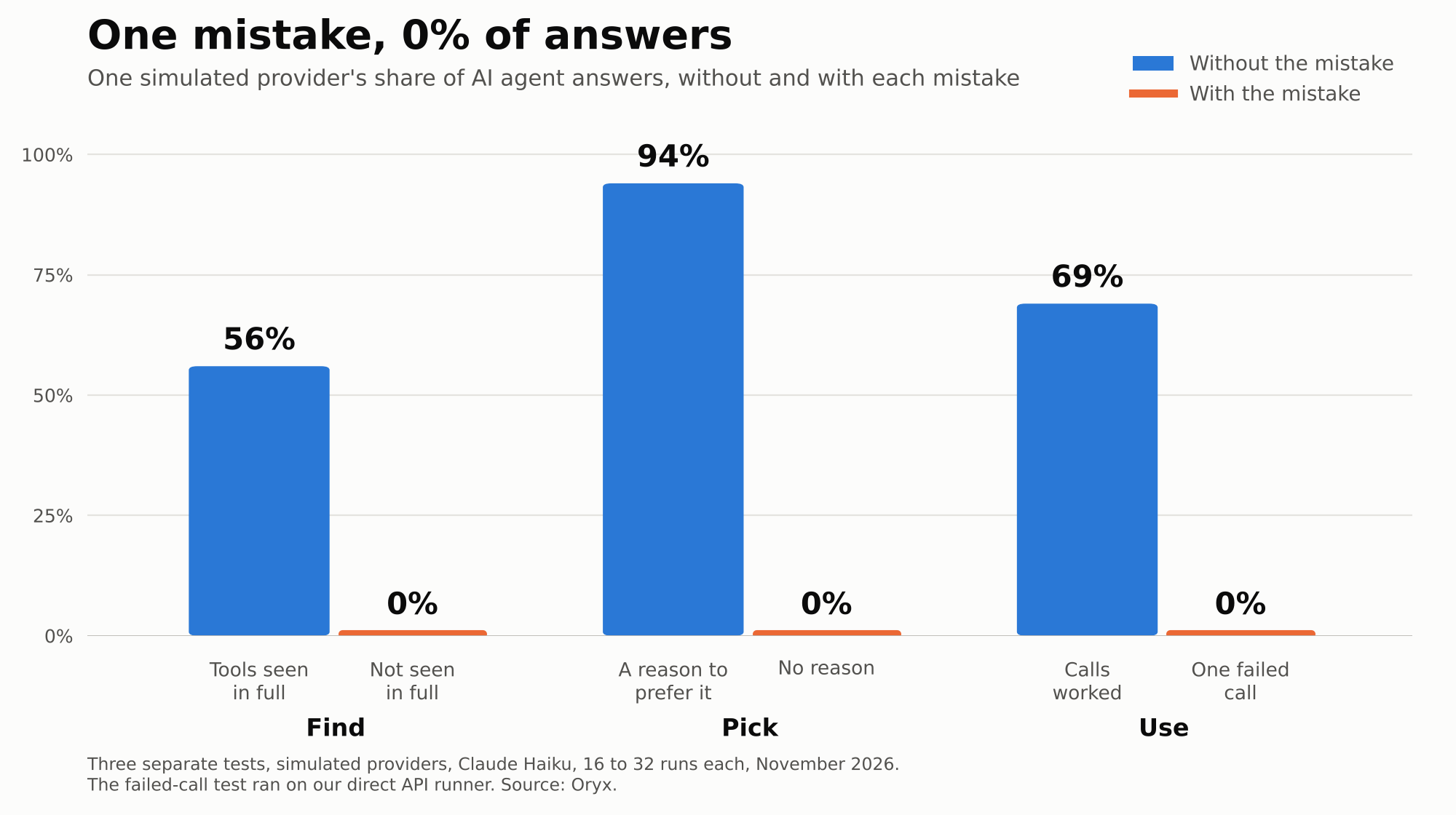 Three separate tests, simulated providers, Claude Haiku, 16 to 32 runs each, November 2026. The failed-call test ran on our direct API runner.
The nine mistakes at a glance
- The agent has no reason to prefer you. One change took a provider from 0% of answers to 94%.
- One call fails. The provider's share of answers fell from 69% to 0%.
- The agent can't see your tools in full. It went looking for them in only 19% of runs.
- The agent calls you, then answers with someone else. Called in 84% of runs, used in none.
- Ties go to the name that sorts first. A look-alike listed ahead took 81% of answers.
- Your biggest jobs have no route. The agent's fallback got the right number in only 33% of runs.
- Your MCP server mirrors your API. A thin wrapper of endpoint tools got 73% of answers right.
- The agent can't read your docs. Our research agents couldn't, for about 1 in 6 vendors.
- Praise and keywords don't help. Each won about 6% of answers, no better than changing nothing.
Do AI agents choose your MCP server, and get its numbers right? Book a 15-minute technical briefing →
Why share of agent answers decides whether your MCP launch worked
Many data vendors have launched an MCP server so that AI agents put their data to work. The launch will be judged on adoption.
But being connected isn't being used. Agent share is the share of agent answers that rest on your data: your AI agent market share. Your dashboard counts installs and calls. It can't show you where the answers went.
Here are nine mistakes we measured, starting with the costliest.
1. The agent has no reason to prefer you
With the same data and nothing to tell providers apart, the agent often settled the tie with the free filing: 44% of answers.
Then we changed one thing about one provider, without touching its data or its place in the list. From second place, it went from 0% of answers to 94%. From third place, it still won 94%. Across the test, the free filing fell from 44% to 3% Measured.
The change claimed nothing about being better. It gave the agent a reason to choose.
This is one of the failures we cover in the briefing. The free outside-in review that follows uses public sources only: no access or keys. 15 minutes →
2. One call fails, and the agent moves on
A provider that took most answers lost all of them after a single failed first call. A clearer error message won back only about 12% Measured.
One failed first call can cost you every answer that follows.
3. The agent can't see your tools in full
At the start of a session, the agent may see only part of a server's tools. When that happened to one provider, it got 0% of answers, whether it was first or second in the list, with the same data as its look-alike Measured.
The agent rarely went looking. It searched for that provider's tools in only 6 of 32 runs. Even then, it fetched the data and answered with the other provider.
From your side, this looks like fewer calls, with no hint of where the answers went.
4. The agent calls you, then answers with someone else
The agent called one provider in 84% of runs, compared its figures with the others, and answered with someone else's number every time. Every answer was right, just not that provider's Measured.
In one run, the agent explained:
"The two aggregator providers report slightly different figures, so the primary filing is preferred."
Many clients pay for coverage, not per call. Whose number is in the answer is what renewals and partner stories are decided on.
Losing the answer can also mean a wrong one. When the free filing that won had only first-filed figures, right answers fell from 96% to 25%.
5. Ties go to the name that sorts first
Claude Code lists tools alphabetically. When we added a look-alike that sorted ahead of the others, the agent called it first in 31 of 32 runs. It took 81% of answers, and the former winner took 0% Measured.
In one run, the agent called its choice of the first-listed provider "…a judgment call."
A stronger model did the same: on Sonnet, on our direct API runner, the second and third look-alikes got 0%. Tool names changed nothing either: still 0%.
List position is luck, and a rival can take it from you. The provider with a reason to be picked won 94% from third place.
6. Your biggest jobs have no route
About 40% of financial-data vendors document no route for a large request Public docs, such as fundamentals for thousands of companies.
Asked about 240 companies with the usual one-company-at-a-time tool, the agent looped about 240 calls and got the right final number in only a third of runs. The rest fell short: it stopped partway, ran out of budget, or left a total only in its reply. Given a route built for large jobs, it was right every time, at about 2-4% of the model cost per run Measured.
Your logs would show hundreds of calls. They wouldn't show that the job fell short.
7. Your MCP server mirrors your API
An MCP server isn't an API. A developer reads your docs once and writes code that loops, joins and handles defaults. An agent decides every call in the conversation, one turn at a time. One tool per API endpoint hands the agent the developer's job.
About 13 of 27 vendors with an MCP server appear to offer one tool per endpoint Public docs. We didn't test their servers. On one simulated provider, with the same data and the same faults, a server designed for agents got every answer right, and a realistic thin wrapper of about 90 endpoint tools got 73% right Measured.
8. The agent can't read your docs
Our research agents couldn't read the docs of about 1 in 6 financial-data vendors: blocked, timed out or empty Public docs.
We didn't measure what unreadable docs do to calls. Our read: an agent that can't learn what your server covers, or how to call it, has little reason to choose it.
What we did see, in one big-job test: left to itself, the agent found a vendor's API in only 1 of 6 runs Measured.
9. Praise and keywords don't give it a reason
Selling to the agent like a human buyer didn't work. A provider that stacked praise or keywords into its tool text won about 6% of answers, no better than changing nothing Measured.
The agent called the praise "marketing" in about a third of runs. Keyword stuffing made runs about 45% more expensive. Facts won; praise didn't.
Ask yourself
- Does the agent see your tools in full when the session starts?
- When a rival with the same data is listed ahead of you, what makes the agent pick you?
- When the agent calls your server, is your number the one in the answer?
What this means for your MCP launch
Launching an MCP server makes your data accessible to AI agents. It doesn't guarantee they'll find it, choose it over competing sources, or use it in their answers.
Our tests show how a provider can lose every answer at any of those steps. And traditional metrics such as installations and tool calls won't necessarily reveal where that happens.
The question isn't just whether your MCP server works. It's whether agents choose your data when alternatives are available.
Where is your MCP server losing agent share?
The nine failure modes above provide a starting point. But which ones affect your MCP server, and how much agent share they cost you, requires testing your specific setup.
Next step: Book a 15-minute technical briefing to discuss the failures that cost data vendors adoption and accuracy.
From there, we can conduct a free outside-in review of what agents can discover about your offering through its public documentation and listings.
For a complete diagnosis, our Agent-Ready Data Assessment benchmarks how agents discover, select, and use your data, identifies the highest-impact issues, and retests improvements. Preparing to launch MCP? The same approach is available as a Launch Readiness Review.
How we tested
We connected an AI agent (Claude Haiku 5.5 in Claude Code, November 2026) to simulated financial-data providers serving the same seeded data, and asked analyst questions, one change at a time.
- Runs: 6 to 32 per setup. The failed-call, stale-filing, praise and Sonnet tests ran on our direct API runner.
- "Right" means within 1% of the true value. "Used" or "cited" means the number in the answer came from that provider.
- Public-docs figures come from our review of 30 financial-data vendors' public docs (no logins).
- Limits: no real vendor's server was tested. Other models and agent clients are untested.
Think we misread yours? Tell us: https://calendar.app.google/nEeKhZXgvnKnBhDn8.
FAQ
Why aren't AI agents using my MCP server? Being connected isn't being used. An agent has to find your server, pick it over other sources and use it without trouble. In Oryx's tests with simulated financial-data providers, one mistake at any of those steps took a provider to 0% of answers.
Why would an AI agent ignore an installed MCP server? If the agent can't see a server's tools in full at the start of a session, it rarely goes looking. In Oryx's tests, it searched for such a provider's tools in only 6 of 32 runs, and the provider got 0% of answers.
How do AI agents choose between MCP servers with the same data? With nothing to tell them apart, by list order or by the free filing. In Claude Code, which lists tools alphabetically, a look-alike sorted first took 81% of answers. A provider the agent had a reason to prefer won 94% from third place.
Do keywords or praise in MCP tool descriptions help agents pick my server? No. In Oryx's tests, a provider that stacked praise or keywords into its tool text won about 6% of answers, no better than changing nothing, and keyword stuffing made runs about 45% more expensive.
Should an MCP server have one tool per API endpoint? An agent makes each call in the conversation, so one tool per endpoint leaves it the developer's work. In Oryx's tests on one simulated provider, a realistic thin wrapper of about 90 endpoint tools got 73% of answers right; a server designed for agents got every one right.
Do MCP tool calls show my share of AI agent answers? No. In Oryx's tests, an agent called one provider in 84% of runs and used its number in none. Calls show that agents reach you, not whose number ends up in the answer.
References
- Oryx, "Agent tests on simulated financial-data providers", November 2026. Claude Haiku 5.5 in Claude Code, plus Sonnet and a direct API runner where stated; 6 to 32 runs per setup.
- Oryx, "Review of the public MCP and API documentation of 30 financial-data vendors", November 2026.
- Model Context Protocol specification: https://modelcontextprotocol.io