6 MCP Server Mistakes That Make AI Agents Misquote Your Numbers
MCP server testing checks that your tools return data, not that AI agents quote it accurately. On a typical server, 32% of runs ended in a confident wrong number.
Correct data can still reach your clients as a confident wrong number. In Oryx's November 2026 tests (Claude Haiku 5.5 in Claude Code, test financial-data providers), an AI agent got 59% of eight multi-step analysis jobs right on a typical MCP server. In 32% of its runs, it gave a wrong number with no warning.
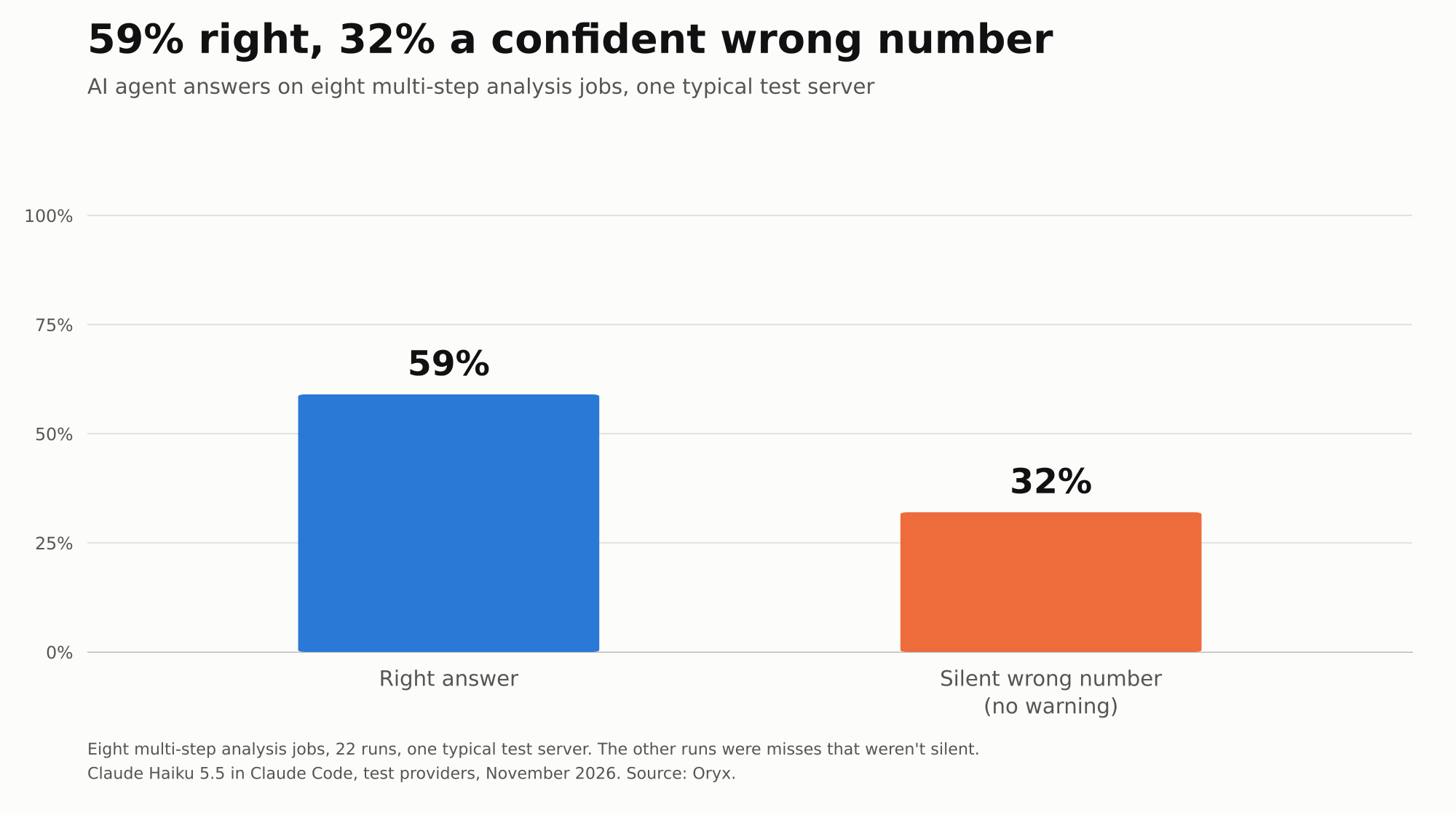 Eight multi-step analysis jobs, 22 runs, one typical test server. The other runs were misses that weren't silent. Claude Haiku 5.5 in Claude Code, test providers, November 2026.
The six mistakes at a glance
- One undocumented default flips the answer. The agent gave the same wrong number, sign flipped, in 100% of runs.
- Your client's own rule gets overridden. With "use final figures" in its instructions, the agent got 0 of 3 runs right.
- A number without its scale is off by a thousand. The agent reported $1.94 million instead of $1,940 million in 2 of 3 runs.
- Restated figures get read as first reports. In one pipeline case, the agent misread restated rows in 28% of runs.
- An error that looks like "no data" becomes a silent gap. The agent gave a silent miss in 13% of runs, documented setups included.
- Company codes get joined to the wrong company. In one pipeline case, the peer table still looked clean.
Do AI agents get your numbers right? Book a 15-minute technical briefing →
Why silent wrong numbers slip past MCP server testing
A wrong number with a warning gets checked. A confident one ships into your client's model or memo, built on your data. A silent wrong number is a wrong number the agent gives with confidence and no warning.
On a typical server, 32% of runs on our eight analysis jobs ended in one. On simpler lookups, a different and easier set, 87% of the misses we counted were silent wrong numbers.
That isn't the agent's ceiling. On the same jobs and data, a differently built server got 95% right, with silent wrong numbers at 5%. Both servers are ours; the typical one is modelled on vendor MCP servers we reviewed.
Your eval suite runs on your own prompts, model and questions. These failures start in your client's setup: house rules, single lookups, pipelines, a failed call mid-job. You could call them the agent's mistakes, but your client still sees a wrong number built on your data.
Here are the six mistakes we measured, starting with the costliest.
1. One undocumented default flips the answer
Wrong in 100% of runs Measured. Nobody asked for a version of the number, so the server's undocumented default decided it. Across two models, the agent gave the same wrong number: −4.41% instead of +3.47%, sign flipped.
In one run's debrief afterwards, Claude Haiku named the doubt it hadn't acted on:
"I did not check whether the final or audited figures differ."
The analyst gets one confident answer that points the wrong way. It passes any consistency check you run.
This is one of the failures we cover in the briefing. The free outside-in review that follows uses public sources only: no access or keys. 15 minutes →
2. Your client's own rule gets quietly overridden
0 of 3 runs right Measured, even though the client asked for the right figures.
An analyst team wrote "use final figures" into the agent's standing instructions. The agent followed the rule and asked for final figures. The server served preliminary figures anyway, and the agent reported them.
Across three house rules, only 5 of 9 runs came back right with the rule alone.
In one run, the agent noted:
"…so I cannot tell from the output alone which basis the data reflects."
Your client did everything right. The answer was still wrong, and the server's logs record a successful call.
3. A number without its scale is off by a thousand
$1.94 million instead of $1,940 million Measured. Asked for revenue, the agent reported a figure a thousand times too small in 2 of 3 runs, in each of two rounds of tests. It guessed, and said so in one run:
"The response gives no scale field, so I inferred this from the magnitude…"
Of the 10 vendors we audited in depth, 0% tell the agent the scale of their money values Public docs.
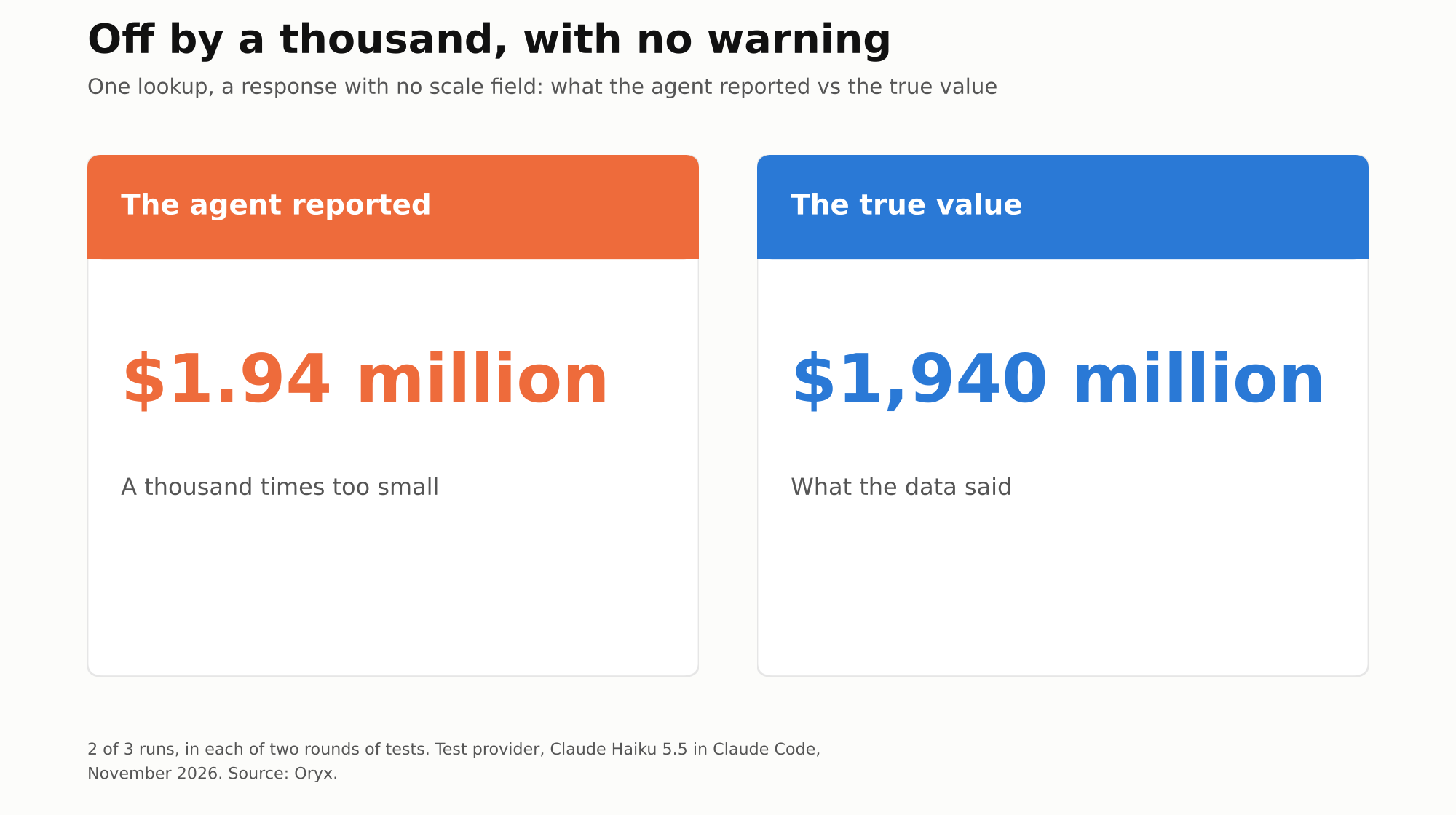 2 of 3 runs, in each of two rounds of tests. Test provider, Claude Haiku 5.5 in Claude Code, November 2026.
With a second number to reconcile against, the agent caught the scale in 100% of runs. A single lookup has nothing to check against.
4. Restated figures get read as first reports
28% of runs Measured. In one pipeline case, the agent read restated rows as first reports, across the setups we ran. Of the 10 audited vendors, 0% flag restated values in the response Public docs.
The cost lands in your client's work: a backtest or peer table built on a number the company later changed.
5. An error that looks like "no data" becomes a silent gap
A silent miss in 13% of runs Measured. A temporary failure returned the same text as an unknown company. The agent took it as missing data and moved on, across four setups, documented ones included.
About 30% of the audited vendors return errors that look like empty data Public docs.
For your client, a company drops out of the analysis without a word.
6. Company codes get joined to the wrong company
Wrong company, clean table Measured. In one pipeline case, the agent joined company codes to the wrong company.
A peer table with one wrong row still looks fine: the format is right and the other rows check out. Your client finds out when someone checks by hand, if anyone does.
What didn't make a difference
Three levers a team would reach for first left the results where they were.
- A larger model. On the undocumented default, Claude Sonnet was also wrong in 6 of 6 runs, for a different reason than the smaller model.
- Documentation, on one hard count. Counting the quarters a company revised after first reporting stayed hard: at most 2 of 3 runs right in each setup, with or without documentation.
- Documentation, on errors that look like data. Silent misses from errors that look like empty data appeared in documented setups too.
Ask yourself
- Does your eval run with your clients' rules, models and pipelines, or only with yours?
- When a client's agent gets one of your numbers wrong, would anything tell you?
What this means for your MCP server
Each of these mistakes started with correct data. The agent got the number wrong because it couldn't tell what the number was. Mistakes 1 to 3 had the highest rates of confident wrong numbers.
Installs, tool calls and adoption don't show where this happens. A clean response and a plausible number look the same whether the answer was right or not.
The question isn't whether your MCP server returns data. It's whether the numbers your clients' agents take from it are right.
Do AI agents get your numbers right?
These six mistakes are a starting point. But which ones affect your MCP server, and what they cost your clients' accuracy, needs testing your own setup.
Next step: Book a 15-minute technical briefing to discuss the failures that cost data vendors adoption and accuracy.
From there, we can conduct a free outside-in review of what agents can discover about your offering through its public documentation and listings.
For a complete diagnosis, our Agent-Ready Data Assessment benchmarks how agents discover, select, and use your data, identifies the highest-impact issues, and retests improvements. Preparing to launch MCP? The same approach is available as a Launch Readiness Review.
How we tested
We connected an AI agent (Claude Haiku 5.5 in Claude Code, November 2026; Claude Sonnet on one test) to test financial-data providers serving the same seeded data, and asked analyst questions, one change at a time.
- Runs: 3 per question in each setup.
- "Right" means within 1% of the true value. A silent wrong number is a wrong number given with no warning.
- Public-docs figures come from our review of 30 financial-data vendors' public docs and open code, 10 audited in depth (no logins; 0% means not seen).
- Limits: no real vendor's server was tested. Other models and agent clients are untested.
FAQ
Why does an AI agent give wrong numbers from my MCP server when my data is right? Because the agent can only use what it can tell about each number. In Oryx's tests (November 2026), an AI agent got 59% of eight multi-step analysis jobs right on a typical MCP server, and 32% of runs ended in a confident wrong number. Server logs would show a successful call, not the wrong answer.
Do AI agents warn you when a number from an MCP server is wrong? Not in 87% of the misses we counted. In Oryx's tests (November 2026) on simpler lookups, those misses were confident wrong numbers with no warning. A number that is wrong the same way in each run also passes a consistency check, so nothing flags it for review.
Why would an AI agent report $1.94 million instead of $1,940 million? When the response doesn't carry the scale of a number, the agent guesses from its size. In Oryx's tests (November 2026), it reported $1.94 million for $1,940 million in 2 of 3 single lookups. Of the 10 financial-data vendors we audited in depth, 0% tell the agent the scale of their money values.
Can an AI agent follow my client's instructions and still get my numbers wrong? Yes. In Oryx's tests (November 2026), an analyst team told the agent to use final figures. The agent asked for them, the server served preliminary figures, and 0 of 3 runs came back right. The server's logs recorded a successful call, so nothing on the vendor's side flagged a problem.