Your MCP Server Gets Called. The Agent's Answer Cites Someone Else
Adoption counts the calls to your MCP server; a tiebreak decides whose number makes the answer. On statement questions, a free filing took 70% of the answers.
Your adoption numbers count calls, but a rule you didn't set decides the answer. In Oryx's November 2026 tests (Claude Haiku 5.5 in Claude Code, test financial-data providers), the agent called two paid providers serving the same data, then answered 70% of financial-statement questions with a free filing's number. When a paid provider's number made the answer, it was the first provider the agent called 93% of the time.
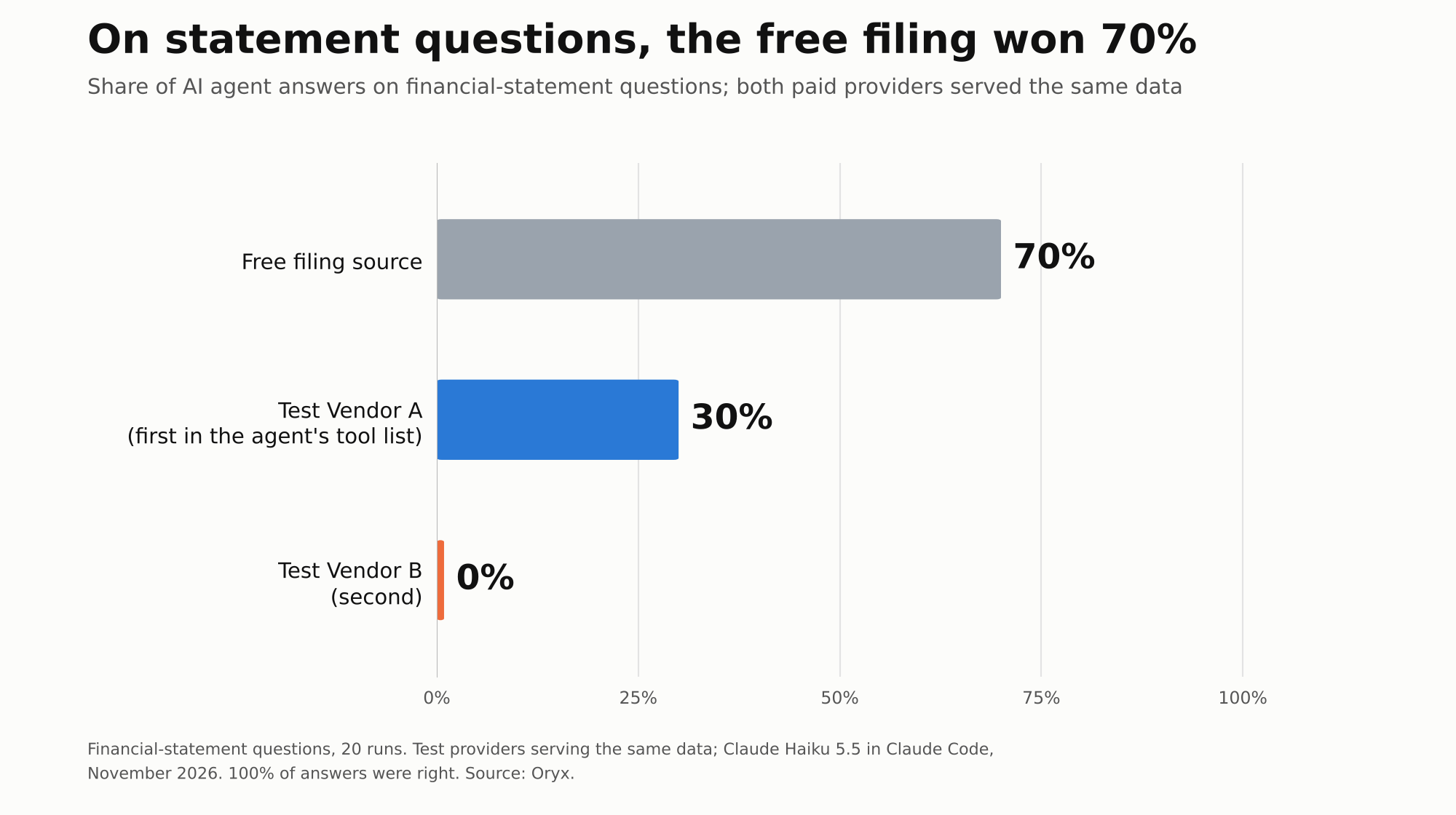 Financial-statement questions, 20 runs. Test providers serving the same data; Claude Haiku 5.5 in Claude Code, November 2026. 100% of answers were right.
At a glance
- On statement questions, a free filing took the answer. It won 70% of them, though the agent had called both paid providers.
- Otherwise, the provider called first won. When a paid provider's number made the answer, it was the first one called 93% of the time.
- Your call counts won't show the loss. The second paid provider was called to check its figures and got 0% of the answers.
- Being right didn't break the tie. 100% of answers were right, whichever source won.
When agents call your MCP server, is your number the answer? Book a 15-minute technical briefing →
What did the agent actually do?
It called both paid providers, found their figures differed by a hair, and needed a tiebreaker.
We gave an AI agent real analyst questions and three sources: Test Vendor A, Test Vendor B and a free filing source. Both paid providers served the same data.
The agent called Test Vendor A, then Test Vendor B. Their figures differed by about 0.1%, and the agent noticed. Its reasoning, in one run:
"The differences are small (under 0.12%), but they are not rounding errors."
In one run, it concluded:
"I could not tell which provider is correct from the data alone."
The agent called Test Vendor B in 84% of runs. Its number was in 0% of the answers.
We built the tie on purpose. Many fundamentals come from more than one source, so what decides the answer when the data agrees?
Two tiebreakers decided the answers
Neither was better data, and neither shows up in a provider's logs.
Tiebreaker one: "the primary filing." On financial-statement questions, where the filing had the figure, it won 70% of the answers. Test Vendor A took the other 30%. Test Vendor B got 0%.
In one run, the agent explained:
"The two aggregator providers report slightly different figures, so the primary filing is preferred."
In 86% of the answers that went to the filing, the agent's justification used the word "primary".
Going to the filing can be the sensible call. The cost to you is who decides: a rule you didn't set and can't see.
Tiebreaker two: whoever was called first. When a paid provider's number made the answer, it was the first provider the agent called 93% of the time.
100% of answers were right either way, so accuracy never broke the tie. Your server can do its job and still lose the tiebreak.
This is one of the failures we cover in the briefing. The free outside-in review that follows uses public sources only: no access or keys. 15 minutes →
Why agent share matters to your connector
Agent share is the share of agent answers that rest on your data. Adoption counts the calls. Agent share counts the answers.
When the filing or the first-called provider wins, your server was called to compare. Your number never reaches the analyst's memo, yet your call counts hold up.
Many clients pay for coverage, not per call. Whose number is in the answer is what renewals and partner stories are decided on. That's our read: we measured answers, not renewals.
Why you can't see it from your side
Your logs record the call, the latency, maybe the payload. They don't show which number the agent used. That is decided later, inside the client's session.
A client's session puts a second source in the room. An evaluation of your tools alone never does, so it never stages the tiebreak.
Your call count looks the same whether you won the answer or lost it.
If your number lost the tiebreak today, what would tell you?
What didn't make a difference
- Being right. Test Vendor B's data was as good as the winner's, and 100% of answers were right. It still got 0% of them.
Measured - Tool names. With longer, plainer names or short codes, the second provider stayed at 0% of answers.
Measured - Our harness. On our direct API runner, the same pattern appeared: the first provider and the free filing took the answers, and the second provider got 0% again.
Measured · API runner
Ask yourself
- When the agent has your data and another source's, what reason does it have to answer with yours?
- Do you know how often your number is the one in the answer, or only how often you're called?
What this means for your MCP server
Being called is only the first step. With another source holding the same data, the agent still chooses whose number goes into the answer, on a rule you didn't set.
Installs, tool calls and adoption count the step before that choice. Your logs show the comparison call. They can't show who won the tiebreak.
The question isn't whether agents call your MCP server. It's whether your number is the one in the answer.
When agents call your MCP server, is your number the answer?
These two tiebreakers are a starting point. Which one affects your MCP server, and how much agent share it costs you, takes testing your own setup.
Next step: Book a 15-minute technical briefing to discuss the failures that cost data vendors adoption and accuracy.
From there, we can conduct a free outside-in review of what agents can discover about your offering through its public documentation and listings.
For a complete diagnosis, our Agent-Ready Data Assessment benchmarks how agents discover, select, and use your data, identifies the highest-impact issues, and retests improvements. Preparing to launch MCP? The same approach is available as a Launch Readiness Review.
How we tested
We connected an AI agent (Claude Haiku 5.5 in Claude Code, November 2026) to test financial-data providers serving the same seeded data, plus a free filing source, and asked analyst questions.
- Runs: 16 to 32 per setup. The first-called figure pools one sweep's runs where a paid provider's number made the answer. Repeat check: our direct API runner.
- "Right" means within 1% of the true value. "Used" or "cited" means the number in the answer came from that provider.
- List order is Claude Code's.
- Limits: no real vendor's server was tested. Other models and agent clients are untested.
FAQ
Why does an AI agent call my MCP server but cite another source? Because calling and answering are separate steps. In Oryx's tests (November 2026), an agent called two paid test providers with the same data, saw their figures differ slightly, and broke the tie on something else: a free filing took 70% of financial-statement answers. Your call logs record the call, not whose number won.
Why would an AI agent pick a free filing over a paid data provider? In Oryx's tests (November 2026), when two paid test providers with the same data differed slightly, the agent settled it with "the primary filing". The filing took 70% of statement answers, and 86% of those justifications used the word "primary". 100% of answers were right, so accuracy never decided it.
How do AI agents choose between two MCP servers with the same data? In Oryx's tests (November 2026), the call order decided it: when a paid provider's number made the answer, it was the first provider the agent called 93% of the time. Tool names didn't change it: the second provider stayed at 0% of answers. Nothing in your own logs shows this order effect.
Why doesn't my MCP call volume show lost answers? The agent calls first and decides whose number to use afterwards, inside the client's session. In Oryx's tests (November 2026), a test provider the agent called to check its figures got 0% of the answers. Your logs see the call, not the decision, and a test of your tools alone never stages the choice.